Cheshire and Merseyside blueprint will help health and care systems and providers across the UK to reduce deaths caused by heart attacks and strokes
Posted:
Posted:
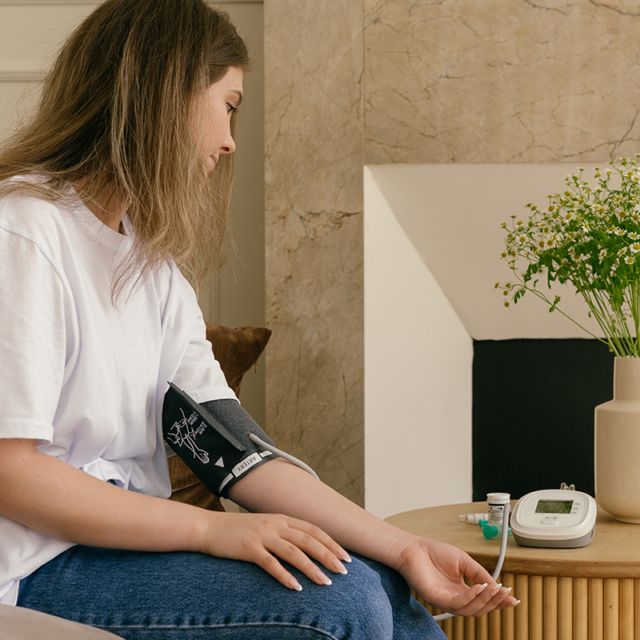
Health and care systems and providers across the UK, will soon be able to take advantage of a blueprint that’s being developed by the Cheshire and Merseyside Health and Care Partnership’s Digital First Primary Care team, that’ll capture their learning from the rollout of a new national programme called ‘BP@Home’. A programme, that is distributing 220,000 blood pressure monitors to people across the country, who have been diagnosed with uncontrolled high blood pressure (hypertension) and who could benefit from regular checks. With Cheshire and Merseyside being one of the first integrated care systems to trial the programme, and already having issued 20,000 monitors to people across the footprint, to help to reduce the number of deaths caused by heart attacks and strokes in the region.
The blueprint, which is due to be released early next year on the FutureNHS Collaboration platform, will provide step by step guides and share learning from the local rollout of the programme, that can then be tailored by other healthcare systems and providers to suit their own local needs and requirements. Including, sharing how the local programme used digital enablers to empower patients across Cheshire and Merseyside to monitor their blood pressure levels and submit readings electronically to their GP (General Practitioner) outside of a clinical setting, and in the comfort of their own homes, in a process known as ‘remote monitoring’. Whilst also highlighting examples of the support that was provided to clinicians, to enable them to receive the measurements recorded by patients, and flag any observations linked to the potentially fatal onset of hypertension, which is often referred to as the “silent killer”.
The blueprint is also significant, in that it’ll be one of the first of its kind aimed at supporting improvements in primary care settings, such as in general practices and community pharmacies. Currently, the majority of NHSX blueprints are aimed predominantly at mental health or acute care settings, such as hospitals and hospices. Therefore, it’s hoped that not only will the blueprint be used to aid digital enablers and clinicians in their roles to support the rollout of BP@Home across the country, but that the approach utilised can be replicated to support other digital programmes of work. Particularly those in primary care settings, using ‘remote monitoring’, the process of using technology to enable patients to monitor health parameters (such as blood pressure and blood sugar levels, peak expiratory flow, and pulse oximetry), whilst alerting clinicians to any deterioration in their condition.
Speaking about the development of the Hypertension Blueprint, Sally Deacon, Programme Lead for the Hypertension Accelerator Project, that’s part of the Cheshire and Merseyside Health and Care Partnership’s Digital First Primary Care programme, said: “High blood pressure is a common condition that can cause CVD (cardiovascular disease), heart attacks and strokes, and many cases of dementia, if it’s not detected and monitored appropriately. Improving how we monitor blood pressure, presents one of the biggest opportunities to save lives, minimise the burden of disease for patients, and reduce inequalities, and that’s why my team and I are so passionate about capturing and sharing our learning from our work here in Cheshire and Merseyside. We recognise that as well as it being utilised to improve outcomes for patients that may suffer from hypertension, there is also significant opportunity for the blueprint to be used by other healthcare systems and providers across the country, to improve the detection and management of long-term conditions in general”.
Alex Chaplin, Chief Digital Information Officer, at the Cheshire and Merseyside Health and Care Partnership added: “As a Digital Programme, we’re so passionate about supporting NHSX’s Blueprinting Programme, by developing and sharing knowledge assets like this Hypertension Blueprint, because we’re not just striving towards ‘Making a Difference through Digital’ in Cheshire and Merseyside, but where we can, across the country. By taking an approach that builds on NHSX’s ‘What Good Looks Like Framework’, and utilising blueprints not just as a mechanism that enables us to support people within our region, to digitise, connect and transform services safely and securely, but also to empower people working for other health and care systems and providers as well. As it’s only through working together and sharing our learning in a joined-up way, that we can truly begin to utilise digital technology to support us in tackling some of the core challenges that we face collectively. For example, the increasing number of patients we’re seeing nationally with long-term health conditions, and comorbidities (having one or more additional conditions that are often concurrent with a primary condition). A demand, which can be tackled, in part, using processes like remote monitoring, that can help to enable the delivery of safer, more effective, and efficient care to patients. Whilst also empowering healthcare professionals to recognise early signs of deterioration, which in turn can improve outcomes for patients, and ultimately save lives.”
The Cheshire and Merseyside Health and Care Partnership’s Hypertension Blueprint is due to be released early next year, and will be available on the FutureNHS Collaboration platform within the GDE Community’s Blueprinting workspace. To gain access to GDE blueprints, including the Hypertension Blueprint, when it becomes available, you can request access to the platform by visiting the FutureNHS website.